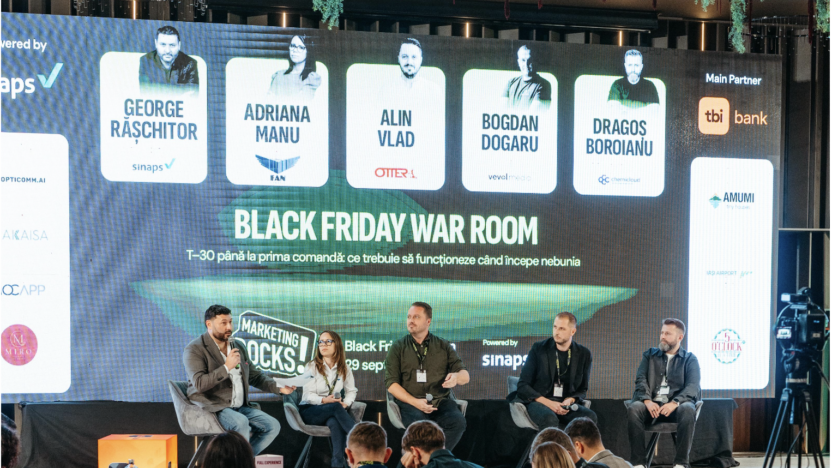
Yesterday I had the pleasure of joining Marketing Rocks #3 in Iași, where I took part in the Black Friday War Room panel and had the opportunity to talk about something we deal with every day at ChemiCloud: what really happens behind the scenes when traffic grows, infrastructure gets pushed to its limits, and every second starts to matter.
A day before the event, I wrote about what I was expecting from the discussion. Now that it’s over, I can say it was even better than I expected.
Great discussions, great people, a lot of interesting questions and, most importantly, the kind of conversations that continue after you leave the stage. This event was also personally important to me for another reason: it was my first public event as CEO of ChemiCloud.
ChemiCloud has been a huge part of my professional life for many years, so representing the company on stage in this new role made the experience even more special.
What we talked about
The idea behind the Black Friday War Room was to look at Black Friday as one complete system.
It is not just marketing.
It is marketing, eCommerce, technology, infrastructure, operations and logistics all having to work together at exactly the same moment.
My part of the conversation was naturally focused on infrastructure under pressure.
We talked about capacity planning and load testing before a major campaign, bottlenecks that sometimes only become visible under heavy traffic, monitoring and observability, scaling, caching, databases, third-party dependencies and incident response.
One of the main points I wanted to bring to the discussion was that adding more servers or more resources does not automatically solve every performance problem.
Sometimes the bottleneck is somewhere completely different.
It can be the application, a plugin, a database query, an external API, a payment integration or another dependency in the chain.
And this is exactly why testing before the traffic arrives matters so much.
Black Friday starts long before Black Friday
One thing I think companies sometimes underestimate is how early the technical preparation for a major campaign needs to start.
At T–30, you still have time to test, identify bottlenecks, simulate traffic and make structural changes.
At T–7, your options become much more limited.
And once the campaign is live and the traffic starts arriving, you are no longer preparing.
You are responding.
At that point, good monitoring, clear incident-response procedures and knowing exactly where to look can make an enormous difference.
The goal is not simply to make sure that a website stays online.
The goal is to make sure that the entire customer journey continues to work under pressure — from the first page view, to search, product pages, add to cart and finally checkout.
A website can technically be online while the customer experience is already failing.
Pages can become slower, database queries can start queuing, external APIs can time out, checkout can become unreliable or a third-party dependency can become the real bottleneck.
That is why proper load testing needs to go much further than simply sending a large number of requests to the homepage.
You need to understand how the complete system behaves when real customers start using it at scale.
Sometimes more infrastructure is not the answer
Another topic I really enjoyed discussing was the difference between an infrastructure problem and an application problem.
When a website becomes slow during a traffic spike, one of the first reactions is often:
“We need a bigger server.”
Sometimes that is absolutely the correct answer.
But not always.
If the real bottleneck is an inefficient database query, a badly behaving plugin, an external service or an integration that can only process a limited number of requests, adding CPU and RAM may simply move the problem somewhere else.
This is where monitoring and observability become extremely valuable.
You need to understand what is happening across the infrastructure, application, database and external dependencies instead of guessing where the problem is.
And ideally, your monitoring should tell you that something is going wrong before your customers start telling you.
Representing ChemiCloud
For me, this event also marked a new chapter. It was the first time I stepped on stage at an event as CEO of ChemiCloud.
ChemiCloud has always been built around a fairly simple idea: hosting should just work.
But making hosting “just work” involves a lot of complexity behind the scenes, especially when customers are running businesses where downtime or poor performance can translate directly into lost revenue. Being able to bring some of that experience to the Marketing Rocks audience — and explain infrastructure not just in terms of servers, CPU and RAM, but in terms of real business impact — was something I genuinely enjoyed.
It also reminded me how important it is for technology companies like ChemiCloud to be part of conversations that go beyond the hosting industry itself.
Infrastructure is only one piece of the puzzle.
What really matters is how that infrastructure supports the business running on top of it.
The conversations after the panel
One of my favorite parts of events like this actually happens after you leave the stage.
A big thank you to everyone who came over afterwards, introduced themselves, asked questions or wanted to continue some of the topics we discussed during the panel.
I really enjoyed those conversations.
It is always interesting to hear what other companies are experiencing, what problems they are trying to solve and how differently infrastructure, marketing and eCommerce can look depending on the business.
I was also very happy to meet the other speakers, panelists and people presenting at the event.
There were people coming from very different areas of the industry, and that is exactly what makes an event like Marketing Rocks interesting.
You leave with perspectives you probably would not get by staying entirely inside your own area of expertise.
Thank you, Sinaps – Marketing Rocks #3
A special thank you to Sinaps and everyone behind Marketing Rocks for inviting me and for putting the event together.
Organizing an event like this requires a huge amount of work behind the scenes, and I really appreciated the opportunity to be part of it and to bring both the ChemiCloud and infrastructure perspective into the Black Friday conversation.
It was a blast.
I came for the panel, but I left with new conversations, new connections and quite a few ideas to think about.
That is probably one of the best results you can ask for from an event.
Thanks again to everyone who attended, everyone who came to say hello and ask questions, all the other speakers and panelists, and the entire Sinaps and Marketing Rocks team.
Can’t wait for the next one. 🚀